Historic Buildings for Modern Workforce

Old Bones, New Work
There's something about arched windows, century-old plasterwork, and a building that's outlasted earthquakes that a glass curtain wall just can't replicate. Workers are noticing — and increasingly, so are the founders, AI builders, and startup teams deciding where to plant their flag.
The office market has been through a lot. Post-pandemic hybrid work permanently altered what people expect from a workspace, and demand for sterile, same-everywhere corporate offices has been cooling ever since. But one thing nobody fully predicted: as generic office towers empty out, workers are gravitating toward spaces with real character — buildings that feel like somewhere rather than anywhere. Nowhere is this more true than in tech, where the best talent increasingly treats the workplace as a signal of what a company stands for.
That shift has quietly turbocharged adaptive reuse — the practice of repositioning historic buildings rather than demolishing them. In 2025, it's no longer a niche preservation strategy. It's become one of the defining moves in commercial real estate, driven by a convergence of market forces, sustainability goals, and a workforce that's simply done settling for mediocre.
Why Historic Spaces Are Winning — Especially for Tech
Workplace design research heading into 2026 is unambiguous: the next generation of workers wants character, craft, and purpose built into the spaces they inhabit. A workspace that reflects genuine history — exposed brick, ornate facades, vaulted ceilings — doesn't just look better on a team offsite photo. It actually changes how people feel about showing up. For startups and AI companies trying to recruit top talent in a competitive market, that edge is very real.
There's also something fitting about building the future in a place that has already proven it can last. Tech founders tend to think in long arcs — about the products they're creating, the companies they're building, the problems they're solving. A 125-year-old building has a certain gravity to it that a freshly constructed spec suite simply doesn't. It signals ambition without conformity. It says: we're not just another startup in a WeWork.
The coworking industry has increasingly moved toward experience-first design, with the space itself becoming part of the value proposition. Founders and small teams working in characterful buildings report stronger community, better focus, and a harder-to-define but very real sense that the work matters more when the environment does too. And for AI companies in particular — whose pitch to the world is often about building something that endures — working inside a piece of living history isn't a contradiction. It's a brand statement.
Early-stage companies don't need a 5-year lease in a generic tower, they need flexibility. Historic buildings repositioned as coworking spaces typically offer month-to-month terms, all-inclusive amenities, and a built-in community of other builders. For many teams, they also represent the most cost-effective Class B office space with architecture that actually inspires, none of the premium of a new Class A tower, all of the character. Beyond the feel-good factor, there are hard economics at play: adaptive reuse projects offer access to federal historic preservation tax incentives and a dramatically lower carbon footprint. Studies show repurposing an existing building can save the equivalent of 65 years of carbon emissions compared to building new, meaningful for companies with ESG commitments or investors who care about sustainability.
Three Buildings Making It Real
The West Coast has some of the most compelling examples of this trend in action — buildings that have survived fires, earthquakes, and economic downturns, and are now hosting some of the most dynamic startups, founders, and creative teams in the country.
The Rotunda
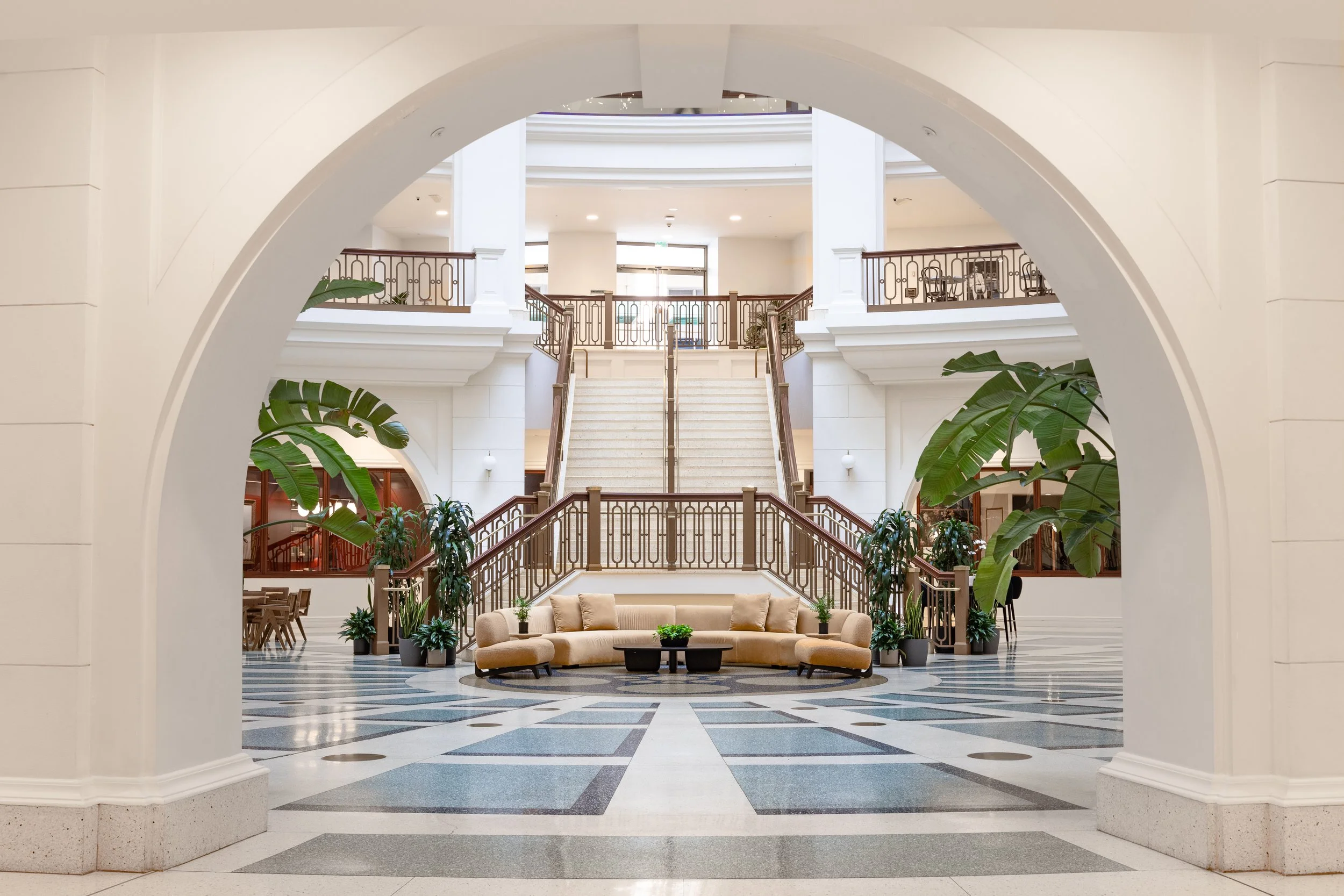
Built in 1913 as Oakland's grandest department store, this Beaux-arts landmark was once the most expensive retail space in the Bay Area, spanning two full city blocks with intricate plasterwork and a soaring glass dome at its center. It survived the 1989 Loma Prieta earthquake, years of vacancy, and the full arc of downtown Oakland's fortune before a historic restoration in 1999 brought it back.
Today it stands as one of the most beautiful historic office spaces in Oakland, a true character space in downtown Oakland that draws founders, creatives, and builders who want more than a generic suite. The dome still presides over a stunning grand foyer. Surrounding it: private offices, a podcast studio, a fully equipped wellness center with a cold plunge, a golf simulator, conference rooms, and The UnCommon Collective, a 50-person event and lounge space. It's the kind of place that makes even a Tuesday feel like it matters.
Explore The Rotunda →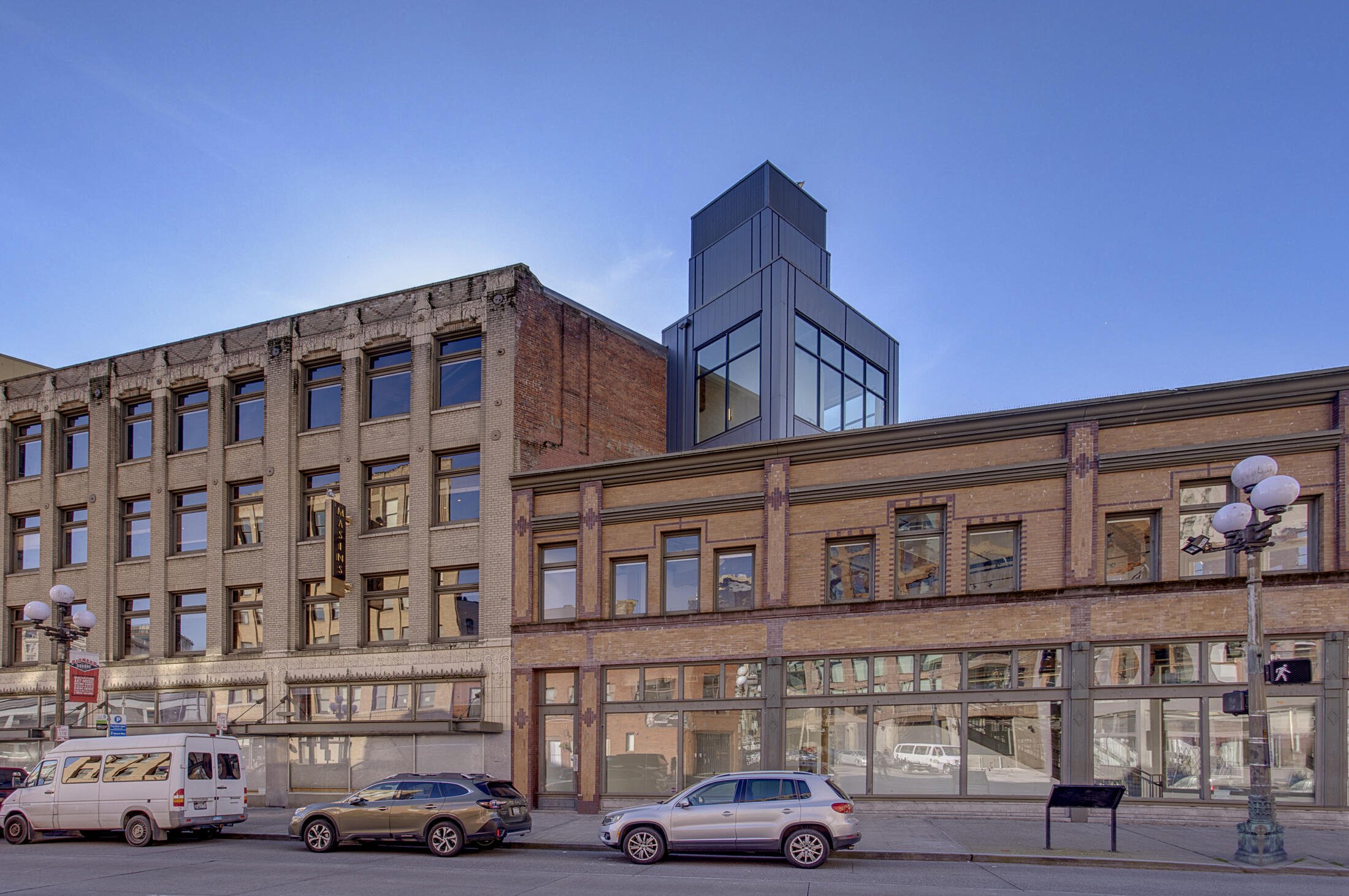
Masin Block
Designed in the late 1800s by Elmer Fisher — the architect behind much of Pioneer Square's iconic post-fire streetscape — Masin Block was commissioned by the Masin family, prominent Seattle furniture dealers who wanted a building that made a statement. Its Romanesque Revival arched windows and intricate stone carvings still stop people mid-stride on the sidewalk more than 125 years later.
The building survived the Great Seattle Fire of 1889, numerous seismic events, and a century of shifting commercial tides. Today it's fully renovated with private offices, hot desks, four conference rooms, and flexible lease terms — steps from Pike Place Market, Occidental Square, and some of Seattle's best lunch spots.
Explore Masin Block →
200 Pine
A classic early-20th-century Financial District building that reflects the neighborhood's commercial legacy — the kind of solid, timeless architecture that looks like it belongs on a city skyline because it genuinely does. The 7th-floor coworking space was designed specifically for AI builders, founders, and early-stage startups who want the energy and credibility of San Francisco's business core without the constraints of a traditional lease.
Steps from Montgomery Street BART and surrounded by some of the city's best dining — Wayfare Tavern, Salesforce Park, and the full Financial District scene — it's a workspace that says "we're serious" the moment a client walks in the door.
Explore 200 Pine →The Takeaway
Adaptive reuse isn't going away — if anything, the combination of high office vacancy rates, rising construction costs, growing sustainability mandates, and a workforce that values experience over square footage means we'll see far more of it. Across the country in 2025, former department stores, century-old schoolhouses, and industrial warehouses are being transformed into the most sought-after workspaces in their cities.
For startups and tech companies especially, the calculus is compelling: flexible lease terms mean you're not locked in while you're still finding product-market fit. Beautiful, distinctive spaces help with recruiting when you're competing against companies with bigger budgets. And the story of the building — its resilience, its history, its refusal to be torn down — aligns surprisingly well with the story most founders are trying to tell about their own companies.
For any growing business thinking about where to plant its flag, the question isn't just how many desks you need. It's what kind of place you want to work in — and what that says about what you're building.
A glass box has its merits. But so does a dome that's watched a city grow for 110 years. The best workspaces aren't just places to sit — they're places that signal who you are, attract the people you want to build with, and make you want to show up every day. For startups, AI companies, and founders who care about the details, historic buildings done right deliver exactly that.
Ready to work somewhere worth working?
Tour our historic coworking spaces across Oakland, Seattle, and San Francisco — built for founders and teams who believe where you work matters.